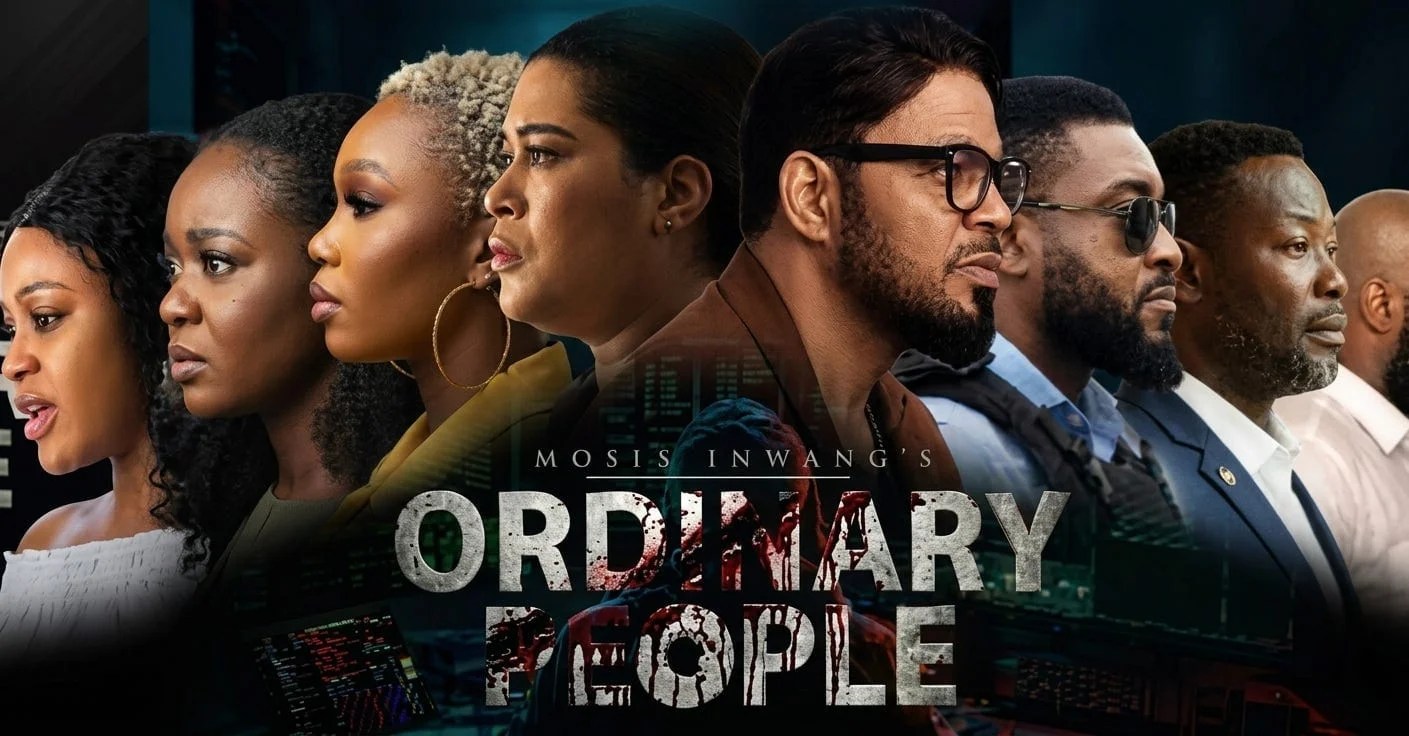
There is something particularly frustrating about watching a series that gives you just enough in the beginning to make you believe it might eventually become something, only for that promise to slowly disappear with every episode. That was my experience with Ordinary People, the eight-episode thriller series written and directed by Moses Inwang.
Set in Mirage Estate, the series follows a group of residents whose apparently ordinary lives conceal secrets, crimes, troubled relationships and, in some cases, entirely different identities. The cast includes Ramsey Nouah, Chidi Mokeme, Adunni Ade, Sharon Ooja, Uche Montana, Lasisi Elenu, Michelle Dede, Jackie Appiah, Adjetey Anang, Shawn Faqua, Gbenga Titiloye and others. The story is built around the idea that the people living behind the neat walls of an affluent estate may not be anything like the people they appear to be.
It is a premise that immediately gives the series somewhere to go. There is a crime story, an undercover operation, domestic abuse, mental health, hidden identities, revenge and people trying to keep their private lives from becoming public. There is also Dare, played by Shawn Faqua, the new resident whose curiosity about his neighbors goes far beyond the usual friendliness of someone settling into a new estate. His hacking and surveillance allow him to see things that the other residents would rather keep hidden.
The problem is that Ordinary People eventually becomes a victim of the very thing that makes its premise interesting. There are too many stories competing for attention, and not enough time is spent making any of them matter as much as they should.
Story: The opening scene immediately throws us into the action. We see a baptism interrupted by a violent shootout involving a runaway, and at first, it is difficult to tell whether we are watching something from the past or something that will happen later in the story.
That uncertainty actually works. The narration that follows takes us into the estate, introduces the residents and begins to establish the different lives that will eventually collide. At this point, so far so good. I got a sense of what the series was trying to do, and I was genuinely interested in seeing how the story would develop. There was enough in Episode 1 to make me look forward to Episode 2.
The characters were not simply what they appeared to be, and the estate itself felt like the sort of place where everyone knew everyone without necessarily knowing the truth about anyone. That gave the series a good foundation for a mystery. Among the residents are Tornado and his wife, played by Ramsey Nouah and Adunni Ade, who are living under new identities while carrying their own history. Chidi Mokeme and Michelle Dede play Tolu and Margaret, an undercover intelligence couple whose seemingly normal marriage is connected to a larger operation. Sharon Ooja plays Emilia, a Nollywood actress dealing with personal problems, while Uche Montana plays Audrey, a woman trapped in an abusive marriage with Pere, played by Lasisi Elenu. There is also Doctor Adebayo, the estate chairman, who has his own secret, while Ghanaian residents Tony and Mercy, played by Adjetey Anang and Jackie Appiah, are hiding problems of their own.
Episode 2 continues to reveal more about the residents. We begin to see deeper into their lives, and the feeling that things can only become more sinister starts to grow. At this stage, the series is still taking its time, but there is enough happening to keep the mystery alive.
By Episode 3, the lives of everyone involved have proven to be more than meets the eye. Even the watcher has a problem. Dare’s surveillance of the estate gives him access to information about his neighbors, but his own intentions and actions raise questions as well.
I was still interested. The series had created enough questions, and I wanted to see how it would answer them.
Then we got to Episode 4. When the questions became the problem. Episode 4 passed like a blur. I think this is where I should admit that I had started watching the series at 1.5x speed because it had begun to feel like a drag. Bodies were piling up, and we were finally seeing how the prime suspects escaped.
I was still curious about what would happen, but I was no longer invested in the people involved.
Would I continue? Yes. Was I invested? No. That distinction became more important as the episodes progressed because Ordinary People had reached the point where I was watching mainly because I wanted answers.
Episode 5 made the problem even clearer. The story was unravelling, but not necessarily in a way that made the mystery more interesting. My questions were begetting more questions. The plot, whatever it was supposed to be at the beginning, increasingly felt like it had entered no man’s land.
Dare, who began as the narrator and resident spy, is now the series’ super-saver. His actions did not always add up, but the story kept finding ways to place him at the center of important developments.
Would I continue? Yes.
Should I? No, but it was already too late. I wanted to see where everything would end.
Episode 6 gave me some hope that we were finally approaching the climax. After all the secrets, surveillance, bodies and overlapping storylines, perhaps the series was finally going to tie everything together. Instead, the episode ended abruptly.
By Episode 7, we were given a long explanatory episode. Some questions were answered, but the answers did not necessarily bring clarity. A few things started to make sense, while other revelations simply opened up new questions. At this point, I was already expecting the ending to be unsatisfactory.
Episode 8 confirmed that feeling. Several words came to mind while watching the finale, but I would go with: very poorly thought out.
After seven episodes of setting things up, this was the moment when everything needed to come together. Instead, the final shootout and the events around it felt like the series was trying to get everything over the finish line rather than giving the story the conclusion it needed.
What Works? The strongest thing about Ordinary People is the idea behind it. The series touches on subjects that are more serious than the crime and thriller elements initially suggest. Mental health and domestic violence are among the social issues Moses Inwang has said he wanted to explore through the story. He explained that the idea grew from observing his own neighbors during the COVID-19 lockdown and wondering whether people who appeared friendly on the surface could be hiding very different lives behind closed doors.
That is a good foundation. The problem is not the number of themes. The problem is what happens to them after they are introduced.
There are moments where the series works because we are allowed to see the contrast between the public and private lives of the characters. Audrey’s relationship with Pere, for example, introduces a very different kind of tension from Tornado’s criminal history. Emilia’s storyline brings mental health into the estate, while Tolu and Margaret introduce the undercover element. These could have been separate but interconnected stories that gave the series real depth.
The Characters: This is where Ordinary People could have done considerably more. After eight episodes, I could not say that I particularly liked or hated any character. I could not say that I strongly resonated with the story of one person or that another character’s journey stayed with me after an episode ended. That is a strange place for a series like this to find itself because the entire premise depends on the audience becoming interested in the people behind the masks.
Uche Montana was one of the performers who stood out to me. Audrey’s situation gives the actress something more intimate to work with, and her performance makes some of those scenes feel more grounded. Sharon Ooja also pulled her weight, particularly with a character whose storyline requires the audience to understand what is happening beneath the surface.
Lasisi Elenu surprised me as Pere. Seeing him in a role that is not built around the comic persona audiences may be more familiar with showed that there is more range there than one might initially expect. Michelle Dede also did alright.
Ordinary People has several strong themes that could have been properly developed, but instead of choosing a few and giving them room, it keeps adding more. Then another plot comes. Then another corpse. Eventually, the individual stories begin to compete with each other.
Having eight episodes does not automatically mean every idea needs to be included. Some of these stories needed more development. Others probably needed to be simplified. Instead, the series keeps moving from one revelation to another.
I think the writer got tired at a point and allowed the story, as intertwined as it was, to fall where it may.
Dialogue and continuity: There were also dialogue and continuity misses that were noticeable as the series progresses. Dare calling Chinelo something else and Tornado referring to Lavender 3 as his son’s class after previously mentioning Purple 3. When a series has this much going on, consistency becomes even more important.
The technical side: The cinematography was not good enough for a production of this scale. The VFX scenes were another weak point. Some of the effects were distracting, particularly when they were supposed to make the action real. They instead made certain scenes feel less convincing.
And then there is the use of AI. AI can be useful in filmmaking when it is used carefully, at least use it well.
The final shootout should have been one of the moments where everything came together. Instead, it was another missed opportunity. After spending seven episodes with these characters, I wanted the final confrontation to mean something beyond the fact that several people had guns and were shooting at one another. It did not give me that feeling. The scene felt poorly thought out, just like several other parts of the finale.
Moses Inwang has spoken about developing Ordinary People over six years, with the project eventually becoming an eight-part series that was shot across Lagos, Bayelsa and Berlin. He has also described the project as an attempt to make something that could reach beyond the Nigerian market.
If this is a project that spent that much time in development, then I have to ask why the final story still has so many moments where it feels as though somebody needed to stop and ask, “Do we really need this?”
Ordinary People did not try to do something that hadn't been done before in Nollywood. A couple of series come to mind that explored similar territory and panned out better. This could also have done the same, except somewhere along the way, they lost the thread. And perhaps that is the most frustrating part of it all.
My emotions and expectations started uphill with Episode 1 and went steadily downhill towards the end. The first episode made me curious. The next few kept me interested. By the middle, I was questioning the direction. By the final episode, I was mostly trying to understand how everything was supposed to fit together.
Eight whole episodes, and I cannot say that I loved or hated a particular character. I cannot say that I resonated with the story of one person. I cannot say that another character’s actions made me laugh or cry or even stayed with me after the episode ended.
Unless it's abjectly bad, which Ordinary People really isn't, I don't have an aversion to a filmmaker writing, directing and producing their own project, but Ordinary People would have benefited from more eyes, more minds and more ideas. Someone needed to challenge the story.
Cast
1. Ramsey Nouah — Tornado
2. Adunni Ade — Chinelo
3. Chidi Mokeme — Tolu
4. Michelle Dede — Margaret
5. Sharon Ooja — Emilia
6. Uche Montana — Audrey
7. Lasisi Elenu — Pere
8. Shawn Faqua — Dare Laguda
9. Adjetey Anang — Tony
10. Jackie Appiah — Mercy
11. Gbenga Titiloye — Dr Adebayo
12. Eddie Watson — Osaro
13. Bimbo Manuel
15. Aproko Doctor
16. Margaret Echeghe
17. Ronnie Dikko
18. Henry Orakwu
19. Brutus Richard
20. Ogechi Ukonu
21. John Evans
Key Crew
1. Moses Inwang — Director
2. Moses Inwang — Creator
3. Adesukanmi Balogun — Producer
4. David Eruotor — Producer
5. Henry Isiguzo — Producer
6. Wesley Johnston — Director of Photography
7. Dennis Benson — Editor
8. Emmanuel-King Itegboke — Post-Production
9. Ngozi Obasi — Costume and Wardrobe
10. Victor Akpan — Art Department