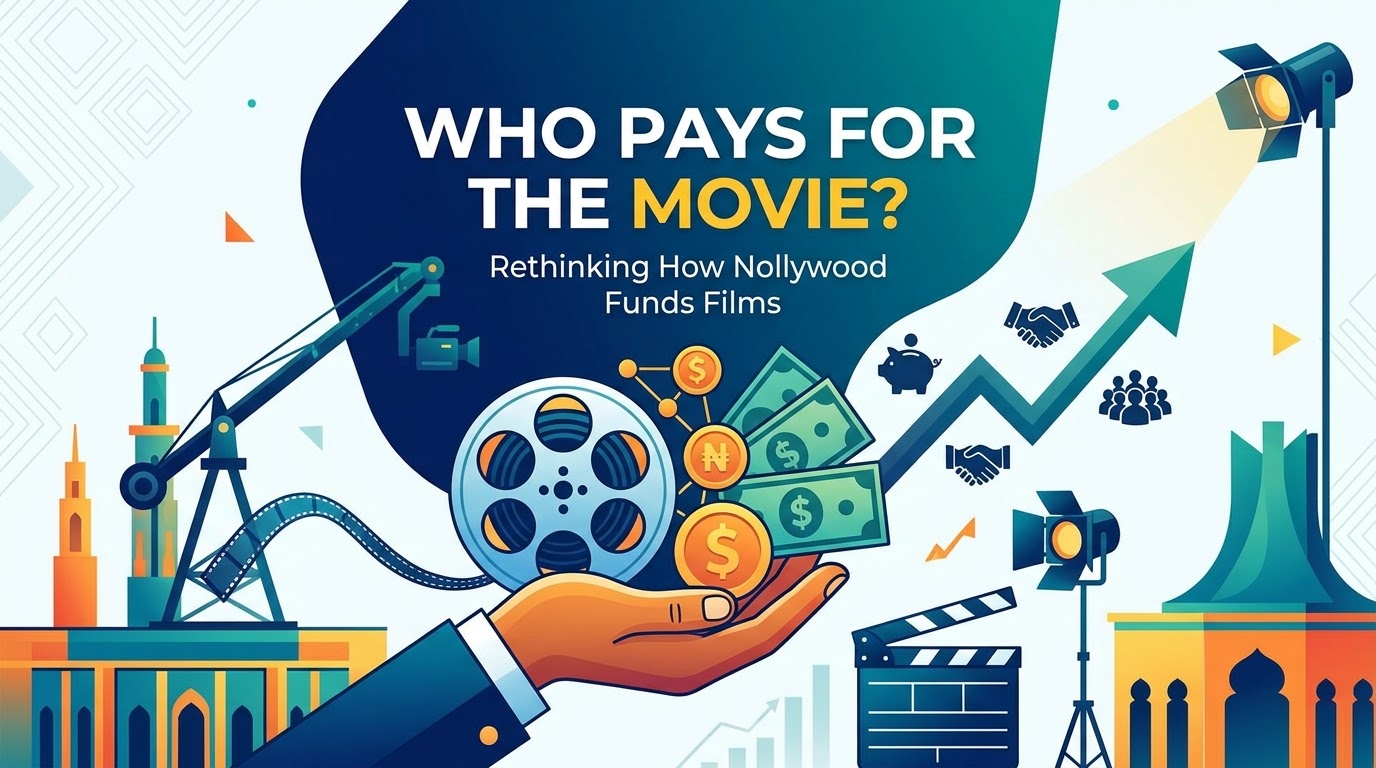
Who actually pays for the movie? The question is becoming increasingly important at a time when Nigeria is announcing billions of naira and hundreds of millions of dollars in financing initiatives for the creative economy. The government's Creative Economy Development Fund, for example, is explicitly designed to increase access to finance for creative businesses, including film.
Yet for many filmmakers, particularly those without established names or networks, financing a film remains one of the hardest parts of the process. So perhaps the problem is not simply that Nollywood lacks money. Perhaps Nollywood lacks a sufficiently structured system for getting the right money to the right films.
Money Exists. Access Is the Question: For an established filmmaker, a strong track record can open doors. For a young filmmaker with an excellent script but no previous box-office success, those same doors may remain firmly closed.
This creates an uncomfortable question: Are we financing an industry, or are we financing individual careers? If available capital repeatedly goes to filmmakers who already have access, the industry may become financially safer in the short term but less innovative in the long term.
New voices struggle to emerge. New production companies struggle to build track records. And investors continue to see the same familiar names as the safest options. This is not necessarily because investors do not want to support emerging filmmakers. It is because investment is fundamentally about risk.
A Good Film Is Not Automatically a Good Investment: A filmmaker can look at a 100-million-naira budget and see a great script, a talented cast, beautiful cinematography and an important Nigerian story.
An investor sees something else: How does my 100 million come back? A great story does not automatically equal a commercially viable film. A famous actor does not guarantee box-office success. And a large production budget does not guarantee that the film will recover its costs.
This is where Nollywood needs to become more comfortable discussing filmmaking as a business. Before an investor puts money into a film, there should be a clear understanding of the audience, budget, distribution strategy, marketing costs, revenue projections, rights ownership and recoupment structure.
The conversation cannot simply be: "This is an important story. Please support it."
It has to become: "This is the story, this is the audience, this is what it will cost, this is where it will be distributed, this is how the revenue will be generated, and this is how your investment can be recovered."
That is not the death of creativity. It is what allows creativity to become sustainable.
Not All Funding Is the Same: Another part of the problem is that the word funding is often used as though all money comes with the same expectations.
A grant is generally designed to support a project or organization without the same repayment expectation attached to a loan. A loan must be repaid, usually with interest. Equity investment works differently, an investor puts money into a company or project in exchange for an ownership interest or participation in future returns.
A socially driven documentary might be suitable for grant funding. A commercially structured production with a strong distribution agreement may be more suitable for debt. A production company building a catalogue of intellectual property may be better positioned for equity investment.
Nollywood therefore needs more than money. It needs financial structures designed around the economics of filmmaking.
Where Does Distribution Come In? Perhaps one of the biggest mistakes in film financing is treating distribution as something that happens after production.
It should be part of the financing conversation from the beginning. If a film costs100 million, the producer should already be asking:
- Where will it be shown?
- Who is the audience?
- What territories can it travel to?
- What are the cinema prospects?
- Can it secure a streaming license?
- Is there television, airline, educational or international sales opportunities?
- What happens to the intellectual property after the initial release?
A film is not just a product. It is an intellectual property asset that can generate different kinds of revenue across different windows.
This is where data becomes critical. Investors need reliable information about audiences, genres, box-office performance, streaming behaviour, distribution and consumer willingness to pay. Without data, investment decisions become heavily dependent on instinct and reputation.
Can Social Impact Become Part of the Financing Strategy? A film addressing education, climate change, women's economic participation, youth development, healthcare or cultural preservation may be relevant not only to audiences but also to foundations, development organisations, NGOs, corporations and impact investors.
This does not mean every film should be forced to become a social-impact project. It means the industry should become better at identifying the different kinds of value a film can create. The financing system should be sophisticated enough to recognise these different forms of value.
Nigeria Needs Film Finance Specialists: One of Nollywood's biggest financing problems may not be the absence of financial institutions. It may be the absence of financial professionals who understand film. Evaluating a film is not the same as evaluating a rice mill. The economics are different. The assets are different. The risks are different.
A film has intellectual property, talent, distribution rights, audience behaviour, marketing variables and unpredictable demand. The goal should not be to remove risk. It should be to structure risk intelligently.
For the Filmmaker Without Connections: The young filmmaker with a powerful story but no established network needs a pathway into that room. That could mean development funds, proof-of-concept financing, transparent application systems, producer accelerators, credit guarantees, investor-readiness programmes and smaller financing windows for emerging filmmakers.
A filmmaker should not have to become famous before becoming financeable. The project itself should have an opportunity to earn credibility.
Nollywood Needs a Financing Ecosystem: Nollywood has already demonstrated that Nigerian stories can travel. The next challenge is proving that those stories can be financed and monetized through a system that works repeatedly.
That requires filmmakers to become more financially literate. It requires investors to understand the peculiarities of film. It requires distributors to enter conversations earlier. It requires better data. Most importantly, it requires everyone involved to accept the basic rules of investment. Profit matters. Loss matters. Risk matters. Accountability matters.
So, who pays for the movie? Today, it may be the producer, the family, the private investor, the bank, the distributor, the government or a combination of all of them. The future of Nollywood should be one where a filmmaker does not need a famous name, a wealthy friend or an extraordinary personal network to get a good film financed.