
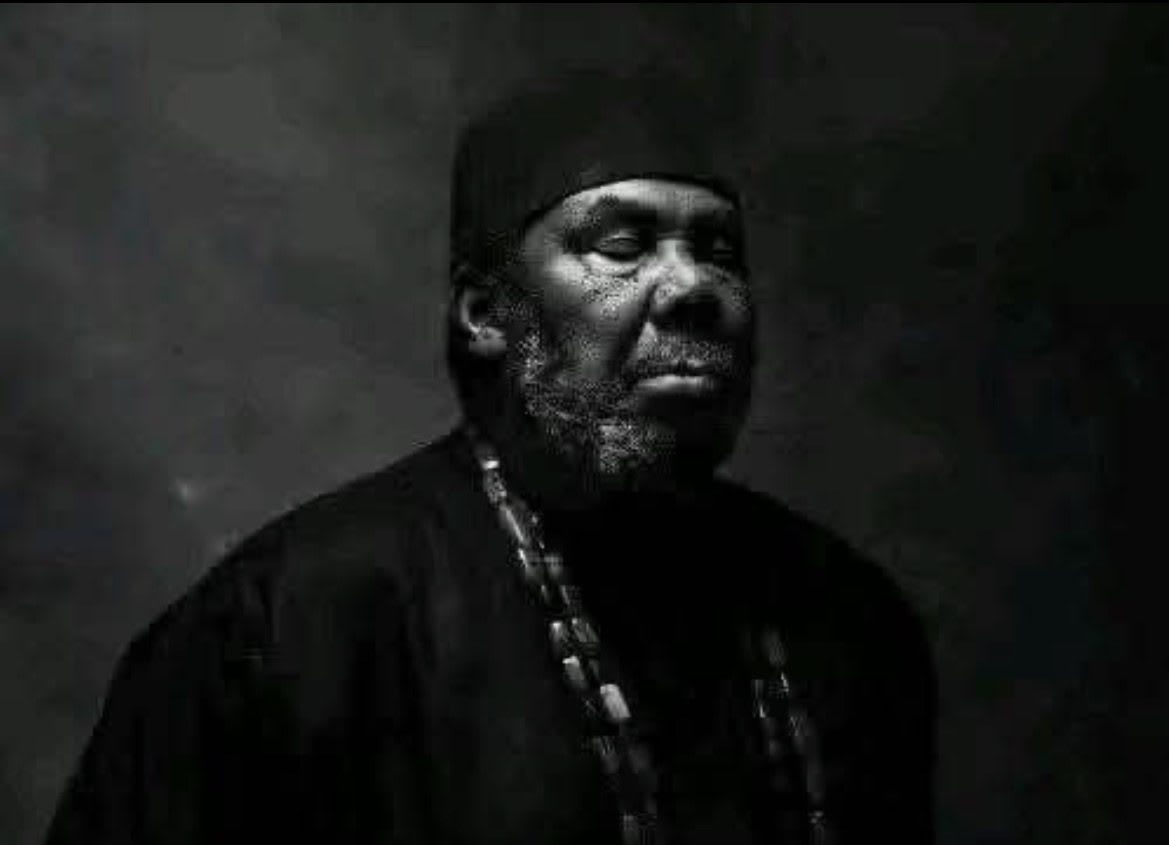
Nollywood has lost a legend. Nigeria has lost an institution. Chief Dr Pete Edochie, MON, is dead.
If there is one year that has reminded us, perhaps more painfully than any other, of the fragility of life and the irreplaceable value of the people who built our entertainment industry, it is 2026. This year has been particularly difficult for Nollywood. We have watched the industry lose several remarkable talents, celebrated actors and people whose contributions helped shape the identity of Nigerian cinema. And just when we thought we had endured enough, another devastating news arrived. This time, it is the man whose name commands a certain kind of respect even in places where Nigerian cinema is hardly discussed.
I was woken up by a telephone call at about 3 a.m. on Wednesday, November 25. Someone had called to ask whether I had heard what was happening and whether the news about the veteran actor was true. Still struggling to come to terms with what I was hearing, I reached for my phone and began checking the social media accounts of members of his family.
I eventually found the announcement on the account of his first son, Chief Leo Pete Edochie. I immediately called back the friend who had contacted me to confirm that, sadly, the news was true. Pete Edochie had passed away.
Before I could properly process what had happened, news of his death was already circulating. Seun Oloketuyi, the filmmaker and founder of the Best of Nollywood Awards, had also shared the news.
According to the statement released by the family and signed by his son, Chief Leo Pete Edochie, the veteran actor died at 12:30 a.m. on Wednesday, November 25, 2026, in Enugu, following a protracted battle with prostate cancer. He was 79.
The family described him as a beloved husband, father, brother and kinsman, and disclosed that he was survived by his wife, Barrister Mrs Josephine Edochie, his children, siblings and other relatives. Funeral arrangements, according to the statement, would be announced in due course.
But beyond the announcement, beyond the headlines and the tributes that will understandably follow, I find myself reflecting on the man I had the privilege of meeting.
I met Pete Edochie a little over two years ago during the production of a documentary on the legendary highlife musician, Mike Ejeagha. It was one of those encounters that live with you, not necessarily because of the occasion, but because of the person you encounter.
For anyone who has met Pete Edochie or had the opportunity to work with him, the description that readily comes to mind is that he was an institution. And I do not use that word loosely.
There was something about his presence. He carried the aura of a man who had seen different generations, witnessed different chapters of history and accumulated experiences that could fill several books. Yet, beneath that imposing presence was a remarkably calm and welcoming personality.
He did not need to raise his voice to command attention. He did not need to announce his importance. There was an unmistakable dignity about him.
During our encounter, he spoke about his experiences in Northern Nigeria, his years in broadcasting, the Nigerian Civil War and the entertainment industry. These were not merely stories told to entertain those listening. Every experience seemed to have a lesson. He would take you through an event, explain the circumstances surrounding it and leave you with something to think about.
You could sit with Pete Edochie for five minutes and leave with enough wisdom to reflect on for a lifetime.
That, for me, was one of the most remarkable things about him. He was not simply an actor who had mastered the art of interpreting characters. He was a man whose life had exposed him to different experiences, and he had the rare ability to communicate those experiences with depth, clarity and perspective.
His journey into the entertainment industry is a story worth remembering.
Long before the word Nollywood became the internationally recognised identity of the Nigerian film industry, Pete Edochie had already established himself as a formidable presence in broadcasting and television.
He began his broadcasting career in 1967 with the Eastern Nigerian Broadcasting Corporation, joining as a junior programmes assistant. Through years of dedication, he rose through the ranks and eventually became Director of Programmes at the Anambra Broadcasting Service, also serving as Deputy Managing Director and, on some occasions, Acting Managing Director.
He was not a man who stumbled into entertainment because he wanted to become famous. He had developed a professional life in broadcasting before his acting career brought him national and international recognition.
His defining moment came with his portrayal of Okonkwo in the Nigerian Television Authority’s television adaptation of Chinua Achebe’s literary masterpiece, Things Fall Apart.
It is difficult to discuss the history of Nigerian television and acting without giving considerable attention to that performance.
Okonkwo was not an easy character to interpret. He was a man of enormous strength, pride, ambition and contradictions, whose fear of appearing weak eventually contributed to his tragic downfall. Pete Edochie brought the character to life with such conviction that, for many viewers, it became difficult to separate the actor from the character.
His interpretation attracted international attention. The BBC came to Nigeria to interview him following the success of the production. In a later interview, Edochie recalled how Chinua Achebe was pleased with his interpretation of Okonkwo, to the extent that the celebrated author referred to him by the character’s name.
That is the kind of artistic achievement that cannot be measured by social media numbers, box office figures or the number of films in an actor’s filmography.
And perhaps this is where we must pause to understand the significance of the man we have lost.
Pete Edochie was already an established actor before Nollywood, as we know it today, emerged in the 1990s. He was not a product of the industry that later became a global phenomenon. Rather, he was among the established performers whose experience and presence helped give the industry some of its identity.
Across generations, he appeared in hundreds of productions, becoming particularly memorable for his portrayals of traditional rulers, fathers, wealthy patriarchs and men of authority. From Igodo to Rituals, and later Lionheart, where he played Chief Ernest Obiagu, his performances demonstrated an actor who understood the importance of character, restraint and screen presence.
His deep voice, deliberate delivery, command of language and remarkable ability to communicate through even the smallest gestures made him distinctive.
But there is something I have always found interesting about Pete Edochie. Although he became widely associated with traditional rulers and authoritative characters, his appeal was not simply about playing a king or an elderly father. It was about the intelligence, conviction and cultural understanding he brought to those characters.
He understood the weight of words, the importance of silence and knew that acting was not about shouting, gesticulating or attempting to dominate every scene. Sometimes, the most powerful performance is delivered through a measured sentence, a calculated pause or a simple expression.
He embodied what a complete actor should aspire to become.
His contribution also extended beyond the screen. He was a custodian of language, cultural expressions, traditional wisdom and historical experiences. His frequent use of proverbs was not merely an acting technique or an attempt to sound philosophical. It reflected an understanding of the place of language and oral tradition in African society.
For a generation of Nigerians who grew up watching him, Pete Edochie was more than an actor. He was a familiar voice, a cultural reference point and a symbol of a particular standard of excellence.
He received several recognitions for his contribution to entertainment, including the national honour of Member of the Order of the Niger (MON), conferred in 2003. He also received the Africa Magic Industry Merit Award and the African Film Academy’s Lifetime Achievement recognition.
These honours were important, but I doubt they could fully capture the extent of his contribution.
We are losing people whose experiences are important to the preservation of our industry’s history.
When Pete Edochie spoke about broadcasting, he was speaking from a period of Nigerian media history that many young filmmakers know very little about. When he spoke about the Civil War, he was drawing from personal experiences and memories that cannot be recreated by watching documentaries. When he discussed acting, he was speaking from decades of professional practice.
These are invaluable archives of knowledge.
And this is why I have always believed that we must do more to document the experiences of our veterans while they are still alive. We cannot continue to wait until people pass away before suddenly remembering how important their stories are.
How many of our young actors have had meaningful conversations with the likes of Pete Edochie? How many filmmakers have made deliberate efforts to document their experiences? How many of our institutions have properly preserved their contributions for future generations?
The death of a legend should also provoke conversations about what we are doing to preserve the knowledge and history of the people who built this industry.
We cannot keep celebrating our veterans only through condolence messages and social media tributes. We must create opportunities for their experiences to be studied, documented and passed on.
For someone like Pete Edochie, there was so much to learn beyond the characters he played. There was the broadcaster, the storyteller, the historian, the cultural custodian and the man who had witnessed Nigeria through several defining periods.
I consider myself fortunate to have met him, even if our encounter was brief. I wish there had been more opportunities to sit with him, ask more questions and listen to more of his stories. But perhaps that is one of the difficult realities of losing people whose presence you have come to appreciate. You begin to remember the conversations you had and the ones you assumed there would always be time to have.
At 79, Pete Edochie has taken his final bow. But his performances, his voice, his interpretation of Okonkwo and the countless lessons embedded in his years of experience will remain.
As a filmmaker, I know that there are actors whose contributions can be acknowledged through their filmography. There are others whose contributions require a much larger conversation about the evolution of the industry itself.
Pete Edochie belongs to the latter category.
Nollywood will continue to make films. New actors will emerge, new stars will command attention, and new generations will create their own histories. But there are certain individuals whose departure leaves a gap that cannot simply be filled by discovering another talented performer.
Pete Edochie was one of them.
An institution has fallen. An era has come to an end. And another chapter of Nigerian entertainment history has closed.
May his gentle soul rest in perfect peace. May God comfort his wife, children, family, friends, colleagues and everyone whose life he touched.


