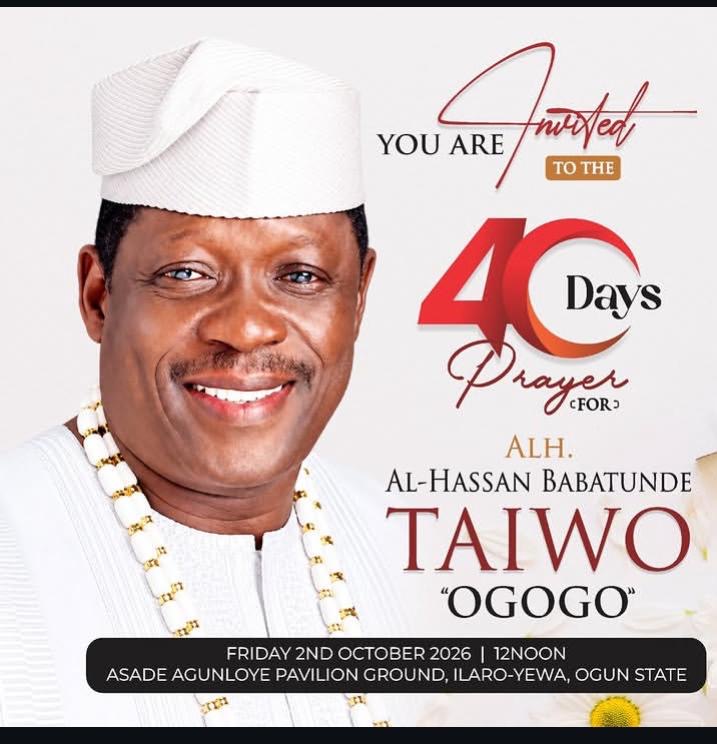
The family of veteran Nollywood actor Taiwo Hassan, popularly known as Ogogo, has announced a 40-day Fidau prayer in his memory, scheduled for Friday, October 2, 2026, at 12 noon, at the Asade Agunloye Pavilion Ground in Ilaro-Yewa, Ogun State. Relatives, friends and well-wishers are being invited to join the family in honouring his legacy and praying for the peaceful repose of his soul, at the same Pavilion Ground where his lying-in-state ceremony took place last month.
Ogogo died on August 23, 2026, at the age of 66, following a battle with stage-four cancer that his daughters had only disclosed publicly days earlier while appealing for medical assistance. His death was confirmed by veteran actor Jide Kosoko on Instagram, and later addressed directly by his daughters, Kira and Shakirat Taiwo, in an emotional live broadcast. He was buried the next day, Monday, August 24, in his hometown of Ilaro according to Islamic rites, drawing a large procession of colleagues, religious leaders and fans to the town.
Born Taiwo Babatunde Hassan on October 31, 1959, in Ilaro, into a family with a documented history of twins spanning his father and grandfather, Ogogo's path into acting started early but unevenly. He first tried performing at 15, in 1974, before the pull of a steady income sent him into work as an auto mechanic with the Lagos State Water Corporation, a job he held for over a decade. It took an Ifa priest and theatre practitioner, Awo Ademola Fabunmi, to draw him back into the arts, recruiting him into a theatre troupe alongside performers like Lalude, Abbey Lanre and Adeolu Funminiyi, a path that eventually set him on course to leave the water corporation for acting full-time.
His defining moment arrived in 1996, when Tade Ogidan cast him as Wole Owolabi in Owo Blow, a role centred on a young man pulled into crime by his family's hardship and haunted by a past he could never fully outrun. The performance won him Best Actor at THEMA '97 and turned him into the face of Yoruba action cinema through the 2000s, a run that produced other memorable work in films like Abule Sowo, Omolomo, Ibinu Elewon and Irapada. Beyond the action roles, colleagues frequently pointed to his command of Yoruba oral tradition, particularly his skill with oriki and chanting, as a mark of the craft that separated him from imitators. Younger audiences would later come to know him through a role in Netflix's Aníkúlápó, decades into a career that had already made him a household name.
His burial drew an outpouring that went beyond the film industry. Odunlade Adekola called him a great star and legend, while Saidi Balogun, referring to him as a brother, prayed for his eternal rest. Actor Bola Oyin-Adejobi's prayer at the graveside captured the mood of many in attendance: "May Allah grant him Al-Jannah Firdaus and give the family the strength to bear the loss." Veteran entertainer Yinka Quadri broke down in tears at the funeral, needing to be consoled by other mourners, while Fuji star KWAM1 was similarly overcome. Senator Solomon Adeola, representing Ogun West, described the death as a monumental loss to the creative industry, the family, Ogun State and the country at large, and pledged continued support to the Hassan family.
The Fidau prayer, a tradition observed in Islam roughly 40 days after burial, gives family and community another opportunity to gather in remembrance, a fitting continuation for a man whose own career was built on drawing people together through story.