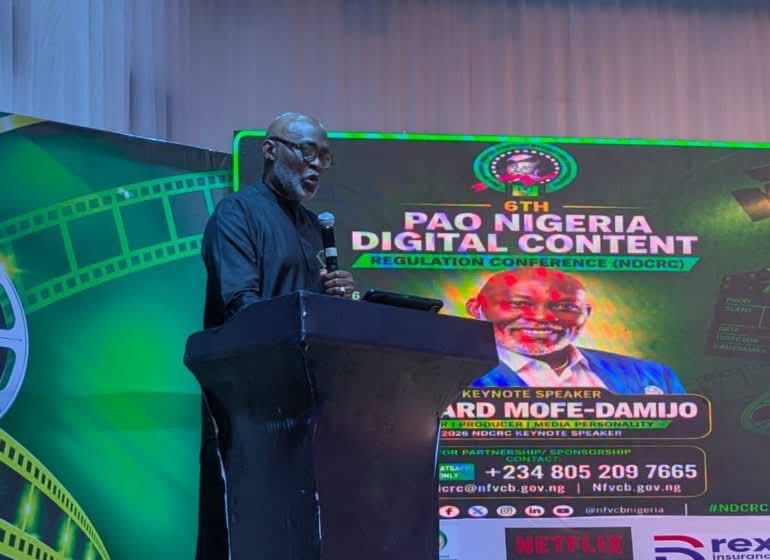
Veteran Nollywood actor Richard Mofe-Damijo, popularly known as RMD, has called for stronger intellectual property protection, improved access to finance and more reliable distribution networks, warning that Africa’s growing cultural influence is not translating into sufficient economic benefits for its creative professionals.
Speaking at the opening ceremony of the 2026 Creative Africa Nexus (CANEX) WKND in Lagos, RMD said the continent had made significant progress in taking its music, films, fashion, literature and visual arts to international audiences but had not built enough economic structures to ensure that creators and businesses benefit from that recognition.
He pointed to the United States, South Korea and India as examples of countries that have used their entertainment industries to promote their cultures, attract investment and create business opportunities. He argued that Africa needed to develop similar structures to turn its cultural influence into sustainable economic value.
For Nollywood, the issue of intellectual property protection remains particularly important as films increasingly circulate through digital platforms. Unauthorised distribution and online piracy can undermine legitimate revenue channels, weaken the commercial value of film rights and make it harder for producers to recover their investments.
RMD argued that global popularity alone does not guarantee prosperity for the people responsible for creating the content. He stressed that recognition must be matched by ownership, investment and systems that allow creators to benefit from the commercial use of their work.
“Africa already has cultural influence, but the challenge is to build economic power that matches it,” he said, adding that the continent needed better access to finance, stronger protection for intellectual property, reliable distribution networks and businesses capable of growing beyond individual success stories.
He also directed separate appeals to investors, policymakers and creatives. Investors, he said, should finance the businesses behind creative talent, while policymakers should create conditions that allow the sector to thrive. He urged creatives to protect their work, establish partnerships and take ownership seriously.
Nigeria already has a legal framework for copyright protection through the Copyright Act 2022, which replaced the previous copyright legislation. The law covers audiovisual works, including films, and provides for the administration and enforcement of copyright by the Nigerian Copyright Commission. However, the existence of legislation does not remove the need for effective enforcement, public awareness and practical systems that allow rights holders to challenge infringement.
The Nigerian Copyright Commission has also repeatedly called for stronger collaboration among copyright owners, digital platforms and enforcement agencies to address online piracy.
RMD’s remarks place the question of ownership and protection alongside the wider conversation about financing and international distribution. For Nollywood, the challenge is not simply getting Nigerian films seen around the world, but ensuring that the people and companies that own those films can control their use and earn from the audiences they reach.
His message at CANEX WKND was that Africa must move beyond exporting its culture and build businesses capable of retaining more of the economic value that its creativity generates.