The Association of Igbowood Indigenous Filmmakers Worldwide has constituted its Abia State chapter with the appointment of seven officers to oversee the affairs of the association in the state.
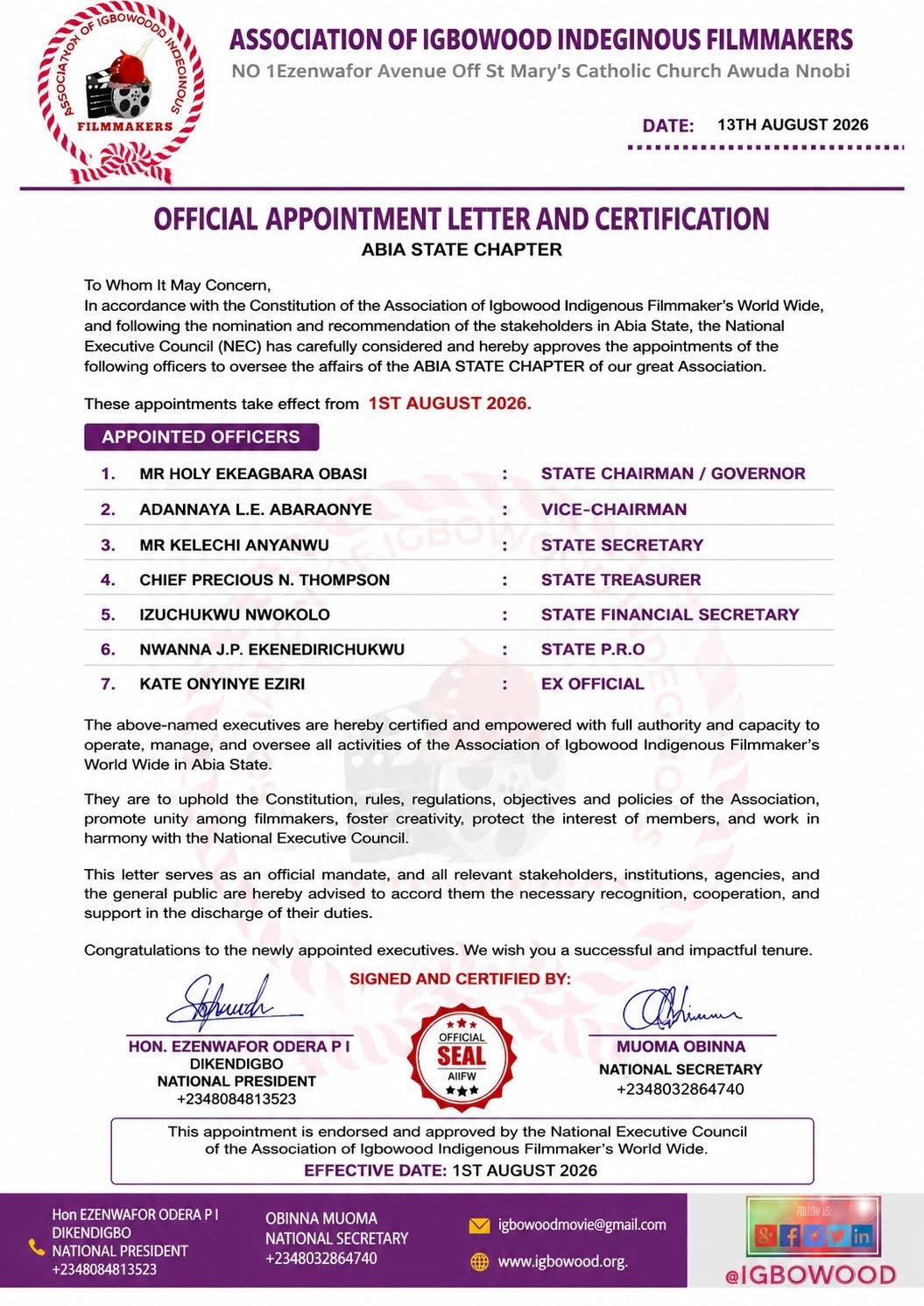
The appointments were contained in an official appointment letter and certification dated August 13, 2026, and signed by the association’s National President, Hon. Ezenwafor Odera PI Dikendigbo, and National Secretary, Muoma Obinna.
According to the document, the appointments took effect from August 1, 2026, following the nomination and recommendation of stakeholders in Abia State and consideration by the National Executive Council.
Mr Holy Ekeagbara Obasi was appointed State Chairman/Governor of the Abia chapter.
Other officers appointed are Adannaya L.E. Abaronye as Vice-Chairman, Mr Kelechi Anyanwu as State Secretary, Chief Precious N. Thompson as State Treasurer, Izuchukwu Nwokolo as State Financial Secretary, Nwanna J.P. Ekenedirichukwu as State Public Relations Officer, and Kate Onyinye Eziri as Ex-Officio member.
The appointment gives the Abia chapter a formal leadership structure with responsibility for representing and coordinating the association’s activities among indigenous filmmakers in the state.
In the appointment letter, the association said the newly appointed executives had been certified and empowered to operate, manage and oversee its activities in Abia State.
The officers are also expected to uphold the constitution, rules, regulations, objectives and policies of the association, while promoting unity among filmmakers, encouraging creativity and protecting the interests of members.
The development comes against the background of a broader movement around indigenous filmmaking in the South-East, particularly efforts to use film as a vehicle for preserving Igbo language, culture and traditions.
Igbowood has been described by its founder, Ezenwafor Odera PI Dikendigbo, as an indigenous film movement created to promote, document, unite, educate and empower Igbo people through filmmaking.
The movement has also developed activities beyond film production.
One of its major platforms is the Igbowood Arts Exhibition, Film Festival and Awards, which brings together indigenous filmmaking, visual arts, cultural performances, pageantry and recognition of individuals contributing to Igbo culture and entertainment.
The 2023 edition, for instance, was planned as a three-day event in Awka featuring an art exhibition, performances, an indigenous film festival, a beauty pageant and awards. The organisers said the initiative was intended to deepen the work of Igbowood in reviving awareness of Igbo culture and tradition.
The following year, the Igbowood Arts Exhibition Film Festival and Awards continued its activities, with the organisers announcing a professional jury that included actors, filmmakers, film critics, academics and media practitioners.
The 2024 edition also featured the crowning of Princess Chiamaka Udealor as Queen of Igbowood Worldwide during a three-day programme in Awka that included a film festival, film premiere, pageantry, masquerade display and awards.
The organisation’s activities form part of a wider development in Nigeria’s film culture, where indigenous-language filmmaking has increasingly been discussed as a distinct component of the country’s larger film industry.
Academic literature has similarly identified Igbowood as a term associated with Igbo-language filmmaking, alongside other regional film identities such as Kannywood and Yoruwood.
For Abia, the establishment of a formally constituted Igbowood chapter carries particular significance.
The state has a notable place in the history of Nigerian home-video filmmaking. Kenneth Nnebue, who was from Abia State, is widely associated with the production of Living in Bondage, the 1992 film that is frequently cited as a major turning point in the development of the Nigerian video-film industry.
That history gives Abia a natural connection to conversations about indigenous filmmaking and the preservation of Igbo stories through cinema.
With the new chapter now in place, the responsibility will be on the appointed executives to translate the association’s stated objectives into activities that directly benefit filmmakers in the state.
This could include creating stronger networks among indigenous filmmakers, encouraging the production of Igbo-language films, supporting emerging practitioners and creating opportunities for collaboration between filmmakers and other cultural stakeholders.
The association’s broader activities also suggest that its interests extend beyond conventional film production to cultural preservation.
That focus is particularly relevant at a time when filmmakers and cultural organisations across Nigeria are increasingly exploring indigenous languages and traditions as sources of stories, characters, locations and creative identity.
The new Abia chapter therefore becomes another local structure through which the Igbowood movement can pursue that objective.
For the newly appointed officers, the immediate task will be to build an active chapter capable of moving beyond the formalities of an executive structure and creating tangible opportunities for filmmakers across Abia.
The appointment also places Mr Holy Ekeagbara Obasi and his team at the centre of efforts to strengthen the association’s presence in one of the South-East states with a long connection to Nigerian filmmaking.
As the Abia chapter begins its tenure, attention will now turn to the programmes, initiatives and collaborations it will introduce and how effectively it can contribute to the growth of indigenous filmmaking in the state.